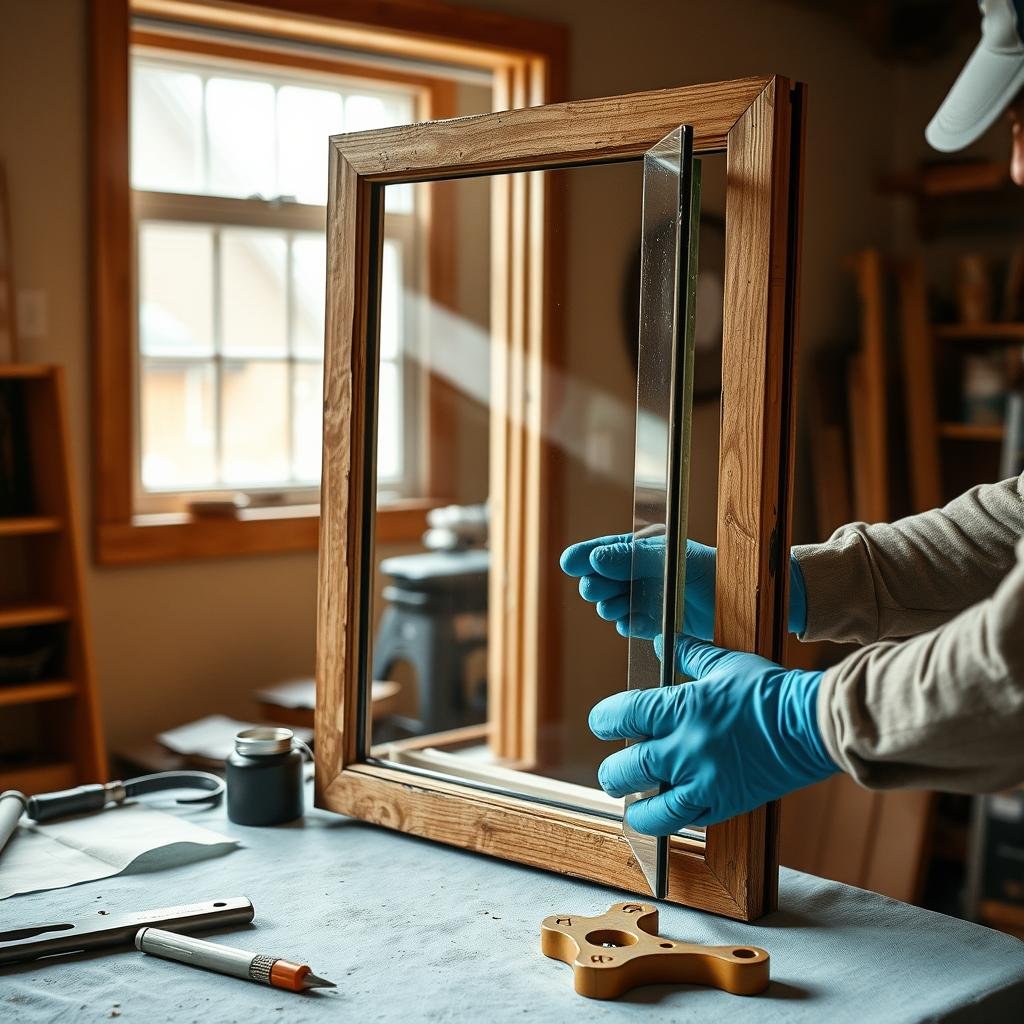
The honest answer is "yes, but here's what that actually costs you"
We field this question about twice a week. The homeowner has a foggy window, got a quote that felt high, opened YouTube, and watched a twelve-minute video that made IGU replacement look like installing a picture frame. So here is the view from the other side - from a glass specialist who has professionally replaced a lot of insulated glass units and also cleaned up a lot of DIY attempts that went wrong.
Nothing in residential glass replacement requires a license in North Carolina or South Carolina. A homeowner is legally free to remove and re-install any piece of glass in their own home, provided the replacement meets the applicable building code (more on that below). The question is not "am I allowed" - the question is "does this project pencil out, and what happens when something goes sideways."
Why window defogging kits do not work
There is a product category sold online - variously called "window defoggers", "Crystal Clear Window", "DIY foggy window repair kits" - that promises to fix a fogged IGU for under $40. The process: drill a small hole through the outer pane, pump in a drying agent (usually isopropyl alcohol), and install a one-way vent or a silicone plug. You will find aggressive marketing for this approach.
It does not last. A 2014 Consumer Reports evaluation of four DIY defogging products reported visible fog returning on three of four test windows within 18 months, and the Insulating Glass Manufacturers Alliance (IGMA) position is clear: once the perimeter seal of an IGU has failed, the argon gas fill has already escaped and the desiccant inside the spacer bar has reached saturation. Drilling the glass lets you evaporate the visible moisture temporarily, but the underlying seal failure keeps drawing new humid air in every time the outdoor temperature changes. The fog comes back. Meanwhile, you now have a drilled hole in a structural piece of safety glass, and any remaining warranty from Pella, Andersen, Jeld-Wen, or Marvin is voided the moment the drill bit makes contact.
The durable fix is IGU replacement - removing the failed glass unit and installing a fresh, sealed unit in the existing frame. That is the job every professional glass shop will quote, and the job any serious DIY attempt has to match.
What DIY IGU replacement actually costs (in time and money)
Here is a realistic cost breakdown for a single standard 32 x 48 inch double-pane window on a vinyl frame, assuming you do not already own the tools:
| Line item | Cost |
|---|---|
| New IGU from local fabricator (standard double-pane, Low-E, argon) | $80-$180 |
| Pair of glass suction cups rated 60 lb each | $40-$80 |
| Structural silicone (ASTM C920), glazing beads, setting blocks | $25-$40 |
| Cut-resistant gloves, safety glasses | $30 |
| Nylon pry tools, heat gun (rental or purchase) | $30-$60 |
| Your time: measure, order glass (1-2 week lead), pick up, install, cleanup | 4-6 hours |
| DIY subtotal (first attempt) | $205-$390 |
| Do-over probability (cracked IGU during install, leak, seal failure under 12 months) | ~40-60% |
| Expected-value DIY cost including second attempt | $285-$500+ |
| Professional IGU replacement (us, same window) | $275-$375 |
On a single window, DIY and professional pricing are roughly tied on cost, and professional wins on time (you save 4+ hours) and on warranty (our IGU carries a 10-year seal-failure warranty; the one you install yourself carries none). On three or more windows, the pro moves further ahead because our travel and measurement time is amortized across the job while your DIY tool spend stays constant but labor time multiplies.
Why DIY IGU replacement breaks so often
The failure modes we see in rescue calls are consistent. In order of frequency:
- Cracking the new IGU during install. A double-pane unit is surprisingly brittle at its edges. Dropping it onto a hard surface, flexing it against an uneven setting block, or over-torquing the frame bead all shatter the outer pane. Replacement glass takes another 1-2 weeks to order.
- Measuring wrong. Modern IGU tolerances are plus/minus 1/16 inch. Measuring the daylight opening instead of the glass pocket, or forgetting to subtract for setting blocks, gives you a unit that either will not fit or leaks air around the perimeter. Fabricators do not take returns on custom-size IGUs.
- Damaging Pella or Andersen retention hardware. On premium brands, the glass is held by proprietary clips, snap-in beads, or keyed stops. Prying blindly with a screwdriver shears off plastic retention tabs that cannot be ordered as a separate part, forcing either a full sash pack purchase ($400-$900) or a full window replacement.
- Seal failure within 12 months. If the perimeter silicone bead is applied too thin, unevenly, or on a dusty frame channel, the new IGU will re-fog on the same schedule as the original. A professional uses a measured bead and pre-cleans the channel with solvent; a DIY caulk-gun pass rarely hits the same quality.
- Code violation on tempered glass. If the opening is within 24 inches of a door, within 18 inches of the floor, within 60 inches of a shower, or at the top or bottom of a staircase, the IRC R308.4 code (adopted by NC and SC) requires tempered safety glass. Installing standard annealed glass in those locations is illegal and creates serious liability if anyone is injured. Pros read the etched tempered stamp on the original unit; DIY homeowners often do not know to look.
The narrow cases where DIY actually works
We will be honest: there are three scenarios where a confident homeowner can realistically replace a foggy window themselves without losing money or safety:
- Single-pane annealed glass in a detached garage, shed, or non-residential outbuilding where code does not require tempered glass and a $275 service call fee exceeds the value of the opening.
- Basement hopper windows in standard vinyl frames with exposed glazing beads (not integrated snap-in systems). These are genuinely beginner-friendly.
- A homeowner with prior glazing experience who already owns the tools. If you have done this before and your tool drawer already has suction cups, a heat gun, and structural silicone, the math is different and the case for DIY is stronger.
For everything else - Pella, Andersen, Marvin, Jeld-Wen, Milgard, Simonton, any IGU over 32 x 48 inches, any opening covered by tempered-glass code, any upstairs window, any patio door, any shower enclosure - the professional numbers beat the DIY numbers on cost, speed, and risk. That is true for us in Marvin NC and it is true for every competent glass shop in the Charlotte metro.
Frequently asked questions
Can I replace a foggy window myself?
Technically yes - there is no law against a homeowner removing and re-installing an insulated glass unit in their own home. Realistically, the combination of precision measurement (tolerance under 1/16 inch), lifting fragile 40-80 lb glass panels, correctly seating a new IGU against dual silicone beads, and handling Pella or Andersen proprietary retention systems means fewer than 5% of homeowners who attempt DIY IGU replacement finish without cracking the new unit, damaging the frame, or re-failing the seal within 12 months. Most glass-repair specialists (ourselves included) will quote a single IGU replacement at $275 to $375 per window, which is almost always less than the tools + replacement glass + second replacement after a DIY mistake.
Do window defogging kits actually work?
No. Defogging kits drill a small hole in the IGU, inject a drying agent, and install a vent or plug. A 2014 Consumer Reports evaluation and multiple peer-reviewed coating-failure studies agree on two things: the cloudiness usually returns within 6 to 18 months because the underlying seal is still failed, and drilling voids the manufacturer warranty and breaks the argon fill that powers the window's energy efficiency. Defogging treats a visible symptom without fixing the root cause (seal failure). Replacement of the IGU is the only durable fix.
What tools do I need to replace a foggy window myself?
Accurate tape measure (1/32-inch resolution), glass suction cups rated for the window weight (typically 60 lb pair minimum), nylon pry tools that will not scar the frame, replacement glazing beads and setting blocks sized to the frame channel, structural silicone sealant (ASTM C920 Type S), a heat gun for removing bead adhesive on newer vinyl frames, a helper to support the old IGU during removal, and proper eye + cut-resistant glove PPE. Plus the new IGU itself, which a local glass fabricator will cut to your exact measurements (expect a 1 to 2 week lead time on custom sizes).
Is replacing glass in a Pella or Andersen window DIY-safe?
No. Pella ProLine, Architect Series, Impervia, and Andersen 400 Series / Renewal use proprietary glazing systems with concealed retention clips, keyed stops, or snap-in beads that are specific to each model year. DIY removal on these brands regularly damages the frame - we replace about 2 per month where the original owner or a handyman attempted removal and sheared off a retention tab. The repair is then either an expensive factory-order sash pack ($400-$900) or a full window replacement ($800+). On these brands we only recommend professional IGU replacement.
When does DIY foggy window repair actually make sense?
Three narrow scenarios: (1) single-pane annealed glass in a detached garage, shed, or non-residential outbuilding where code does not require tempered glass and the cost of a service call exceeds the value of the window; (2) basement hopper windows in vinyl frames with exposed glazing beads; (3) a homeowner with prior glazing experience who already owns the tools. For typical residential double-pane IGUs in main-house windows, DIY almost never pencils out.
What building code issues apply to DIY glass replacement?
Any glass within 24 inches of a door, within 18 inches of the floor, within 60 inches of a tub or shower, at the top or bottom of a staircase, or in any location where a human could reasonably fall into it must be tempered safety glass per IRC R308.4 (North Carolina and South Carolina both adopt this standard). Replacing tempered glass with standard annealed is a code violation and a real liability risk if someone is injured. A professional glazier can tell from the etched corner stamp whether the original unit was tempered and will only install tempered in those locations.
What is the total cost of DIY foggy window replacement vs hiring a professional?
DIY: new IGU from a local fabricator ($80-$180 for a standard double-pane), suction cups ($40-$80), structural silicone + glazing beads ($25-$40), PPE ($30), 4-6 hours of your time, plus a 40-60% chance of needing a second IGU if the first cracks during installation. Realistic total: $180-$500 and half a day. Professional: $275-$375 per window, a 15-minute measuring visit, a 30-60 minute install, and a 10-year warranty. On a single window the numbers are close; on 3+ windows a pro is cheaper because the material cost per unit stays the same while the labor does not scale linearly on DIY.
Have a foggy window and want a second opinion?
We give free, no-pressure measuring visits across 24 zip codes in NC and SC. If your project really is a good DIY candidate, we will tell you - and point you at the local fabricator we use for glass. If it is not, you will have a firm quote in writing before we order anything. No upselling, no surprise charges.
Related reading: Why windows get foggy between the glass • Foggy window repair cost in Charlotte, NC • Glass-only repair vs full window replacement